I believe in the power of music to get us through the darkest times. I’m a living example. When my little brother Scott was senselessly killed in a car crash while riding as a passenger in 1991, my family turned to the music of his favorite artist, Bob Marley, for support. Songs like “One Love” and “Three Little Birds” helped us carry on in the midst of tragedy and grief. I later set out to discover what it was about Marley’s music that had such an impact on people. After 20 years of research and earning a masters degree in theology, I published The Bible and Bob Marley, the first book to explore his use of the Bible in his lyrics.
Marley is a far more complex artist than many people give him credit for. By examining his biblical references in detail, many facets of Marley the man, his music, and message come to light. One image of Marley that appears is that of a wisdom teacher with a profound sense of mission. Songs from “Small Axe” to “Africa Unite” to “Forever Loving Jah” draw inspiration from wisdom books such as Proverbs and Psalms. But he’s not just quoting the texts, he’s interpreting them and finding relevance for the struggles of today. He is teaching an alternative consciousness based on wisdom.
Photographer Kate Simon has described her photo of Marley reading the Bible in an airport as particularly poignant. This was during the Exodus tour and she has another photo of him reading the newspaper. What I draw from these is the fact that Marley related the events of his time to what he read in the Bible, and found in the Bible elements of his own experience. For example, when he felt rejected by his family in 1970, he wrote the lyric, “The stone that the builder refused will always be the head cornerstone,” a direct quotation of Psalm 118.
This is not an anomaly. I’ve identified 137 distinct biblical references in 83 different Marley compositions, and that only covers his period with Island Records. The Bible was integral to Marley’s songwriting from his very first song in 1962, “Judge Not,” quoting Matthew and Luke, to “Redemption Song,” the final track on Uprising, the last album released during his lifetime in June 1980.
Let’s look at the period covered in the recent Bob Marley: One Love movie. Marley’s sense of mission was coming to the fore with the release of Rastaman Vibration in April 1976. It would become his highest charting album in the US during his lifetime. Songs like “Johnny Was” and “Rat Race” provided harsh critiques of the political violence and turmoil in Jamaica at the time, along with relevant Bible passages. After Marley himself was shot and wounded as a political target on December 3rd, 1976, he went into exile in London, launching an internationalization of his message that Jamaican anthropologist Barry Chevannes likened to “Paul’s decision to preach to gentiles.”
Unlike the documentary films that came before it, I was pleased to see how the new biopic hints at the importance of the Bible to Marley. For example, when the Wailers are working on “Natural Mystic,” the foreboding opening track of the Exodus album, the film makes clear how it alludes to the seven trumpets of Revelation chapters 8 through 11.
A recurring theme in the movie is “Redemption Song.” In it Marley tells the story of Joseph, whose brothers cast him into a pit before selling him into slavery. When he sings, “My hands were made strong by the hand of the almighty,” he’s changing the passage from Genesis to the first person, indicating his identification with Joseph.
Beyond drawing inspiration from the Bible and current events, Marley claimed his biggest influences were pan-Africanist Marcus Garvey and Ethiopian Emperor Haile Selassie. The movie has scenes with Marley reading their biographies while on tour and at his London apartment. One of Marley’s most memorable lyrics is from “Redemption Song” and is a quotation from Garvey: “Emancipate yourselves from mental slavery / None but ourselves can free our minds.” The entire lyrics of “War” from Rastaman Vibration are taken from Selassie’s 1963 UN address, which speaks of a day when “the philosophy which holds one race superior and another inferior is finally and permanently discredited and abandoned.” This is the song he opened the Smile Jamaica peace concert with two days after the shooting.
One must also consider the impact of the US Black Power movement on Marley, as it was launched during the summer of 1966 while he was living in Delaware. He is later known to have read Malcolm X biographies. It’s therefore poetic that Kingsley Ben-Adir, who portrayed Malcom X in the 2020 film One Night In Miami, plays Marley in One Love.
Again, Marley is a complex artist who can’t be pigeonholed. He transcends categories like country/city, black/white, Christian/Rasta, and secular/sacred. His timeless wisdom never seems trite because of its seemingly universal applicability to the lives of diverse listeners. To this day, millions of people including myself continue to draw inspiration from this humble mystic with a Bible and guitar.
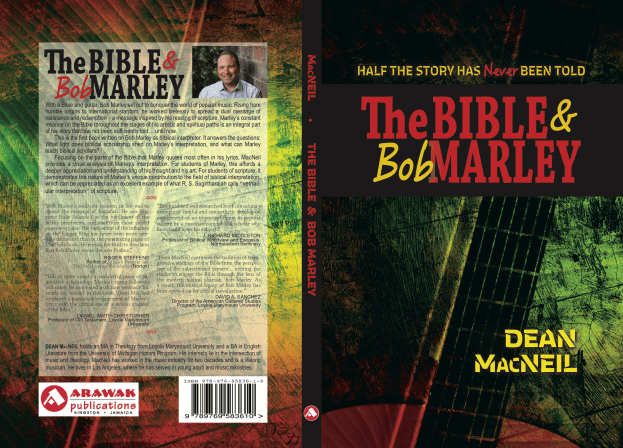

 The Bible and Bob Marley